
Your cart is currently empty!

1.2 Use of calculator memory
Accounting is the process by where a company’s financials are recorded, summarized, analyzed, consulted and reported on.
Bookkeeping is the recording part of this process, in which all of the financial transactions of the business (consisting of income and expenses) are entered into a database.
Expertise in mathematics is not required to succeed as a bookkeeper or an accountant. What is needed, however, is the confidence and ability to be able to add, subtract, multiply, divide as well as use decimals, fractions and percentages. Competent bookkeepers and accountants should be able to use mental calculations as well as a calculator to perform these numerical skills. The ability to use a calculator effectively is as important- as the ability to use a spreadsheet program.
The material in this section covers the essential numerical skills of addition, subtraction, multiplication, division, through to decimals, percentages, fractions and negative numbers. You are expected to use a calculator for most of the activities but you are also encouraged to use mental calculations. In the modern world, the assumption is that we use calculators to avoid the tedious process of working out calculations by hand or mentally. The danger, of course, is that you may use a calculator without understanding what an answer means or how it relates to the numbers that have been used. For example, if you calculate that 10% of £90 is £900 (which can easily happen if either you forget to press the per-cent key or it is not pressed hard enough), you should immediately notice that something is very wrong.
Using a calculator requires an understanding of what functions the buttons perform and in which order to carry out the calculations. Your need to study this material is dependent on your mathematical background. If you feel weak or rusty on basic arithmetic or maths, you should find this material helpful. The directions and symbols used will be those found on most standard calculators. (If you find that any of the instructions contained in this material do not produce the answer you expected, please follow the instructions of your calculator.)
There are four basic operations between numbers, each of which has its own notation:
- Addition 7 + 34 = 41
- Subtraction 34 – 7 = 27
- Multiplication 21 x 3 = 63, or 21 * 3 = 63
- Division 21 ÷ 3 = 7, or 21 / 3 = 7
According to BODMAS, multiplication should always be done before addition, therefore 75 is actually the correct answer according to BODMAS.
(‘Order’ may be an unfamiliar term to you in this context but it is merely an alternative for the more common term, ‘power’ which means a number is multiplied by itself one or more times. The ‘power’ of one means that a number is multiplied by itself once, i.e., 2 x 1, 3 x 1, etc., the ‘power’ of two means that a number is multiplied by itself twice, i.e., 2 x 2, 3 x 3, etc. In mathematics, however, instead of writing 3 x 3 we write 3 2 and express this as three to the ‘power’ or ‘order’ of 2.)
Brackets are the first term used in BODMAS and should always be used to avoid any possibility of ambiguity or misunderstanding. A better way of writing 12 + 21 x 3 is thus 12 + (21 x 3). This makes it clear which operation should be done first.
1.2 Use of calculator memory
A portable calculator is an extremely useful tool for a bookkeeper or an accountant. Although PCs normally have electronic calculators, there is no substitute for the convenience of a small, portable calculator or its equivalent in a mobile phone or personal organiser.
When using the calculator, it is safer to use the calculator memory (M+ on most calculators) whenever possible, especially if you need to do more than one calculation in brackets. The memory calculation will save the results of any bracket calculation and then allow that value to be recalled at the appropriate time. It is always good practice to clear the memory before starting any new calculations involving its use. You do so by pressing the MRC key, representing Memory Recall or its equivalent, twice. (Note: this key is often labelled R.MC or R.CM. The first time the key is pressed memory is recalled and the second time it is cleared. If in doubt about your calculator, consult its manual.)
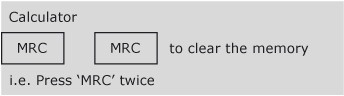
Figure 2
Taking the previous example we can recalculate it using the memory function.
12 + (21 x 3) = 75
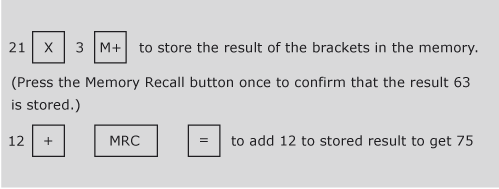
Figure 3
1.3 Rounding
For most business and commercial purposes the degree of precision necessary when calculating is quite limited. While engineering can require accuracy to thousandths of a centimetre, for most other purposes tenths will do. When dealing with cash, the minimum legal tender in the UK is one penny, or £00.01, so unless there is a very special reason for doing otherwise, it is sufficient to calculate pounds to the second decimal place only.
However, if we use the calculator to divide £10 by 3, we obtain £3.3333333. Because it is usually only the first two decimal places we are concerned about, we forget the rest and write the result to the nearest penny of £3.33.
This is a typical example of rounding, where we only look at the parts of the calculation significant for the purposes in hand.
Consider the following examples of rounding to two decimal places:
- 1.344 rounds to 1.34
- 2.546 rounds to 2.55
- 3.208 rounds to 3.21
- 4.722 rounds to 4.72
- 5.5555 rounds to 5.56
- 6.9966 rounds to 7.00
- 7.7754 rounds to 7.78
Rule of rounding
If the digit to round is below 5, round down. If the digit to round is 5 or above, round up.
1.4 Fractions
So far we have thought of numbers in terms of their decimal form, e.g., 4.567, but this is not the only way of thinking of, or representing, numbers. A fraction represents a part of something. If you decide to share out something equally between two people, then each receives a half of the total and this is represented by the symbol ½.
A fraction is just the ratio of two numbers: 1/2, 3/5, 12/8, etc. We get the corresponding decimal form 0.5, 0.6, 1.5 respectively by performing division. The top half of a fraction is called the numerator and the bottom half the denominator, i.e., in 4/16, 4 is the numerator and 16 is the denominator. We divide the numerator (the top figure) by the denominator (the bottom figure) to get the decimal form. If, for instance, you use your calculator to divide 4 by 16 you will get 0.25.
A fraction can have many different representations. For example, 4/16, 2/8, and 1/4 all represent the same fraction, one quarter or 0.25. It is customary to write a fraction in the lowest possible terms. That is, to reduce the numerator and denominator as far as possible so that, for example, one quarter is shown as 1/4 rather than 2/8 or 4/16.
If we have a fraction such as 26/39 we need to recognise that the fraction can be reduced by dividing both the denominator and the numerator by the largest number that goes into both exactly. In 26/39 this number is 13 so (26/13) / (39/13) equates to 2/3.
We can perform the basic numerical operations on fractions directly. For example, if we wish to multiply 3/4 by 2/9 then what we are trying to do is to take 3/4 of 2/9, so we form the new fraction: 3/4 x 2/9 = (3 x 2) / (4 x 9) = 6/36 or 1/6 in its simplest form.
In general, we multiply two fractions by forming a new fraction where the new numerator is the result of multiplying together the two numerators, and the new denominator is the result of multiplying together the two denominators.
Addition of fractions is more complicated than multiplication. This can be seen if we try to calculate the sum of 3/5 plus 2/7. The first step is to represent each fraction as the ratio of a pair of numbers with the same denominator. For this example, we multiply the top and bottom of 3/5 by 7, and the top and bottom of 2/7 by 5. The fractions now look like 21/35 and 10/35 and both have the same denominator, which is 35. In this new form we just add the two numerators.
(3/5) + (2/7) = (21/35) + (10/35)
= (21 + 10) / 35
= 31/35
1.5 Ratios
Ratios give exactly the same information as fractions. Accountants make extensive use of ratios in assessing the financial performance of an organisation.
A supervisor’s time is spent in the ratio of 3:1 (pronounced ‘three to one’) between Departments A and B. (This may also be described as being ‘in the proportion of 3 to 1.’) Her time is therefore divided 3 parts in Department A and 1 part in Department B.
There are 4 parts altogether and:
- 3/4 time is in Department A
- 1/4 time is in Department B
If her annual salary is £24,000 then this could be divided between the two departments as follows:
- Department A 3/4 x £24,000 = £18,000
- Department B 1/4 x £24,000 = £6,000
1.6 Percentages
Percentages also indicate proportions. They can be expressed either as fractions or as decimals:
45% = 45/100 = 0.45
7% = 7/100 = 0.07
Their unique feature is that they always relate to a denominator of 100. Percentage means simply ‘out of 100’ so 45% is ‘45 out of 100’, 7% is ‘7 out of 100’, etc.
A company is offered a loan to a maximum of 80% of the value of its premises. If the premises are valued at £120,000 then the company can borrow the following:
£120,000 x 80% = £120,000 x 0.80 = £96,000
Fractions and decimals can also be converted to percentages. To change a decimal to a percentage you need to multiply by 100:
0.8 = 80%
0.75 = 75%
To change a percentage to a decimal you need to divide by 100:
60% = 0.6
3% = 0.03
To convert a fraction to a percentage it is necessary to first change the fraction to a decimal:
4/5 = 0.8 = 80%
3/4 = 0.75 = 75%
If a machine is sold for £120 plus VAT (Value Added Tax – a sales tax in the UK) at 17.5% then the actual cost to the customer is:
£120 + (17.5% of 120) = £120 + (0.175 x 120) = £141
Alternatively, the amount can be calculated as:
£120 x (100% + 17.5%) = £120 x (1.00 + 0.175) = £120 x 1.175 = £141
If the machine were quoted at the price that included VAT (the gross price), and we wanted to calculate the price before VAT, then we would need to divide the amount by (100% + 17.5%) = 117.5% or 1.175. The gross price of £141 divided by 1.175 would thus give the net price of £120. This principle can be applied to any amount which has a percentage added to it.
For example, a restaurant bill is a total of £50.40 including a 12% service charge. The bill before the service charge was added would be:
£50.40 / 1.12 = £45.00
1.7 Negative numbers and the use of brackets
Numbers smaller than zero (shown to the left of zero on the number line in the figure below) are called negative numbers. We indicate they are negative by putting them in brackets as shown in the figure below.
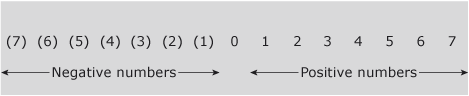
Figure 4
Rules of negative numbers
The rules for using negative numbers can be summarised as follows:
Addition and subtraction
- Adding a negative number is the same as subtracting a positive 50 + (-30) = 50 – 30 = 20
- Subtracting a negative number is the same as adding a positive 50 – (-30) = 50 + 30 = 80
Multiplication and division
- A positive number multiplied by a negative gives a negative 20 x -4 = -80
- A positive number divided by a negative gives a negative 20 / -4 = -5
- A negative number multiplied by a negative gives a positive -20 x -4 = 80
- A negative number divided by a negative gives a positive -20 / -4 = 5
1.8 The test of reasonableness
Applying a test of reasonableness to an answer means making sure the answer makes sense. This is especially important when using a calculator as it is surprisingly easy to press the wrong key.
An example of a test of reasonableness is if you use a calculator to add 36 to 44 and arrive at 110 as an answer. You should know immediately that there is a mistake somewhere as two numbers under 50 can never total more than 100.
When using a calculator it is always a good idea to perform a quick estimate of the answer you expect. One way of doing this is to round off numbers. For instance if you are adding 1,873 to 3,982 you could round these numbers to 2,000 and 4,000 so the answer you should expect from your calculator should be in the region of 6,000.
Test your ability to perform the test of reasonableness by completing the following short multiple choice quiz. Do not calculate the answer, either mentally or by using an electronic calculator, but try to develop a rough estimate for what the answer should be. Then determine from the choices presented to you which makes the most sense, i.e., the choices that are most reasonable.
1.9 Table of equivalencies
The next activity in developing your numerical skills required for bookkeeping and accounting is to give you practice in converting between percentages, decimals and fractions. It is a very useful numerical skill to be able to know or to work out quickly the equivalent between a number given in percentage form and in other forms.
Activity 11
Use the box below to record your answers for the gaps in the table. The first one is done for you. Answers required in decimals should be rounded off to two decimal points. Answers required in fractions should be written in the lowest possible terms.
| Percentage | Decimal | Fraction |
|---|---|---|
| 1% | 0.01 | 1/100 |
| 2% | To use this interactive functionality a free OU account is required. Sign in or register. | To use this interactive functionality a free OU account is required. Sign in or register. |
| To use this interactive functionality a free OU account is required. Sign in or register. | 0.05 | To use this interactive functionality a free OU account is required. Sign in or register. |
| To use this interactive functionality a free OU account is required. Sign in or register. | To use this interactive functionality a free OU account is required. Sign in or register. | 1/10 |
| 20% | To use this interactive functionality a free OU account is required. Sign in or register. | To use this interactive functionality a free OU account is required. Sign in or register. |
| To use this interactive functionality a free OU account is required. Sign in or register. | 0.25 | To use this interactive functionality a free OU account is required. Sign in or register. |
| 33 1/3% | To use this interactive functionality a free OU account is required. Sign in or register. | To use this interactive functionality a free OU account is required. Sign in or register. |
| To use this interactive functionality a free OU account is required. Sign in or register. | 0.5 | To use this interactive functionality a free OU account is required. Sign in or register. |
| To use this interactive functionality a free OU account is required. Sign in or register. | To use this interactive functionality a free OU account is required. Sign in or register. | 2/3 |
| 75% | To use this interactive functionality a free OU account is required. Sign in or register. | To use this interactive functionality a free OU account is required. Sign in or register. |
| To use this interactive functionality a free OU account is required. Sign in or register. | 1.0 | To use this interactive functionality a free OU account is required. Sign in or register. |
| To use this interactive functionality a free OU account is required. Sign in or register. | To use this interactive functionality a free OU account is required. Sign in or register. | 2/1 |
Reveal answer
1.10 Manipulation of equations and formulae
The final activity in developing your numerical skills is to revise the manipulation of simple equations.
Being able to understand and express the Accounting Equation in different forms is crucial to understanding a fundamental accounting concept (the dual aspect concept) and the principal financial statements (the profit and loss account and the balance sheet). You will learn more about the Accounting Equation in sections 2 and 3.
An equation is a mathematical expression which shows the relationship between numbers through the use of the equal sign. An example of a simple equation might be 2 + 3 = 5.
A special type of equation is an algebraic equation where a letter, say ‘x’, represents a number, i.e. in x + 2 = 5, ‘x’ represents 3 in order to make the equation true.
Algebraic equations are solved by manipulating the equation so that the letter stands on its own. This is achieved in the equation x + 2 = 5 by the following two steps.
- x = 5 – 2
- x = 3
The principal rule of manipulating equations is whatever is done to one side of the equal side must also be done to the other, as was shown above.
x = 5 – 2 is achieved by subtracting 2 from both sides of the equation x + 2 = 5, i.e.:
- x + 2 – 2 = 5 – 2
- x = 5 – 2
Manipulating an equation to get the algebraic letter to stand on its own involves ‘undoing’ the equation by using the inverse or opposite of the original operation. In the example of x + 2 = 5, the operation of adding 2 must be undone by subtracting 2 from either side of the equal sign.
The following table shows a number of examples of how equations are manipulated to obtain the correct number for the algebraic letter.
| Operation | Inverse | Equation |
|---|---|---|
| add 7 | subtract 7 | a + 7 = 9 |
| a + 7 – 7 = 9 – 7 | ||
| a = 2 | ||
| subtract 5 | add 5 | b – 5 = 6 |
| b – 5 + 5 = 6 + 5 | ||
| b = 11 | ||
| multiply by 3 | divide by 3 (or multiply by 1/3) | c x 3 = 18 |
| c x 3 / 3 = 18 / 3 | ||
| c = 6 | ||
| divide by 6 | multiply by 6 | d / 6 = 2 |
| d / 6 x 6 = 2 x 6 | ||
| d = 12 |
An equation such as a x 3 = 12 can also be expressed as a3 = 12 or 3a = 12, i.e., if an algebraic letter is placed directly next to a number in an equation it means that the letter is to be multiplied by the number.
The correct number for the algebraic letter ‘a’ in the equation 3a = 12 will be obtained thus:
- 3a = 12
- 3a / 3 = 12 / 3
- a = 4
Manipulating or rearranging formulae involves the same process as manipulating or rearranging equations.
Important note
A formula is simply an equation that states a fact or rule such as S = D / T or Speed is equal to Distance divided by Time.
In the formula S = D / T, S is the subject of the formula. (This simply means that S stands on its own and is determined by the other parts of the formula. By convention the subject is always placed on the left-hand side of the equal sign, although S = D / T means the same as D / T = S)
As we learnt to rearrange or manipulate an equation, the formula S = D / T can also be manipulated to make D or T the subject.
S = D / T
D / T = S (turning the formula around)
D = S x T (multiplying both sides of the formula by T)
Or, from D = S x T
D / S = T (dividing both sides of the formula by S)
T = D / S (turning the formula around)
Take your learning further
Making the decision to study can be a big step, which is why you’ll want a trusted College. We’ve pioneered distance learning for over 6 years, bringing college to you wherever you are so you can fit study around your life.
If you’re new to BJJM Finacco Hub study, read our guide on Where to take your learning next, or find out more about the types of qualifications we offer including entry level Access modules, Certificates, and Short Courses.


Leave a Reply